
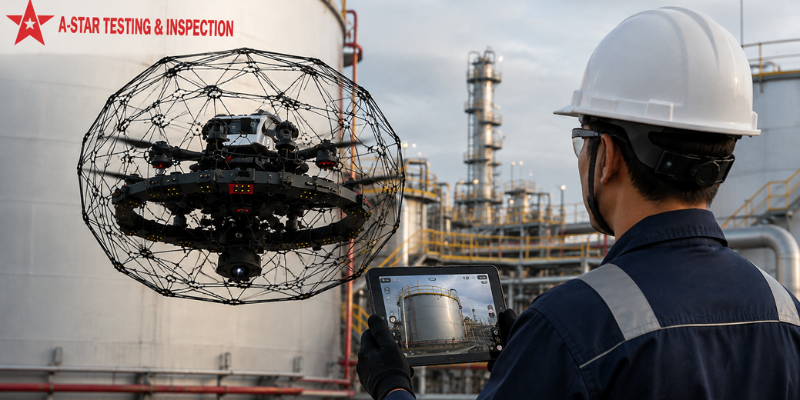
Unmanned aerial vehicles (UAVs) are becoming increasingly popular in industrial facilities as a way to conduct inspections of hard-to-reach areas, gather visual information, and assist with maintenance planning. Elevated to oil and gas facilities, offshore platforms, storage tanks, power plants, and extensive infrastructure, drone technology will be able to streamline the selected inspection processes and make them safer.
Nevertheless, drone service companies must be selected based on more than mere equipment or price. Safety requirements, technical knowledge, data quality, regulatory considerations, and an awareness of asset integrity are all part of industrial inspections. The appropriate provider must have the ability to combine UAV technology and professional inspection practices to provide helpful information that can be used in decision-making in engineering and maintenance.
What Are Industrial Drone Inspection Services?
Industrial Drone Inspection Services are remotely operated or autonomous UAVs with cameras and special sensors to inspect industrial assets by air.
Drones can carry high-resolution images, videos, thermal images, or other information, depending on the project. Such information may aid inspection teams to evaluate visible surface conditions without necessarily necessitating scaffolding, cranes, and long work-at-height operations.
Common uses are visual inspection of tanks, towers, roofs, flare stacks, offshore structures, pipelines, bridges, and other high or inaccessible locations.
Why Choosing the Right Provider Matters
Not all commercial drone operators are experienced in industrial inspection. A provider might possess good UAV equipment but not know much about the inspection process, industrial hazards, or asset integrity needs.
An appropriate inspection partner ought to be familiar with the UAV technology and industrial inspection principles. This union enables drone data to be gathered with a definite objective as opposed to merely generating huge quantities of photographs.
In the case of critical assets, they may lead to missed observations and poor maintenance decisions because of poor quality of the imagery, incomplete coverage, or poor reporting.
Key Factors to Consider When Selecting a Drone Provider
1. Industrial Inspection Experience
Find Drone Inspection Companies that have worked in an industrial setting. Oil and gas, petrochemical, power generation, marine, construction, or manufacturing experience can be of particular interest.
In industrial locations, it may be restricted spaces, moving machinery, high places, electricity, and other hazards that need proper planning.
2. Qualified Drone Operators
UAV personnel should be properly trained and competent, having been appropriately trained by a professional provider. Operators should know how to plan flights, equipment restrictions, weather, emergency procedures, and specific safety requirements of the site.
In the case of industrial projects, drone operation needs to be included as a part of the overall inspection process, and not as an independent photography service.
3. Suitable UAV Equipment
Various drone capabilities are needed to operate various assets. General visual inspections might require high-resolution cameras, but optical zoom cameras or thermal cameras can be used to add further details to a process.
In the assessment of UAV Inspection Services, consider the question of whether the provider is equipped with equipment applicable to the asset, and the quality of image required, the environment in which it is operating, and the purpose of inspection.
4. Data Quality and Reporting
The process of taking pictures is just a portion of an inspection. The data must be arranged, examined, and displayed in a format accessible by inspection and engineering staff.
An effective provider is required to provide transparent documents, picture references, observation of the inspection, and other supporting materials. It may also be easier to make future comparisons and condition monitoring through good reporting.
5. Safety and Risk Management
One of the main factors to consider when choosing a provider is safety. The company ought to show how it addresses risk assessment, flight planning, exclusion zones, weather monitoring, emergency, and coordination with site personnel.
In the case of industrial facilities, the UAV activity will also have to consider the nearby structures, human beings, machinery, and other activities in the field.
How Drone Inspection Supports Asset Integrity
Asset integrity programs can be assisted with the help of Drone Asset Inspection that will provide repeatable visual data concerning the available external conditions.
As an example, the condition of a coating during use can be documented by regular surveys which include visible corrosion, structural components, roofing, equipment appearance, or any other external conditions.
This data can assist maintenance teams to focus on particular areas that need further investigation. Nonetheless, not all types of NDT are substituted by drone inspection. Internal discontinuities, weld defects, or a loss in wall thickness are some defects that might need techniques like ultrasonic testing, radiography, magnetic particle testing, or any other appropriate technique.
Aerial inspection used together with traditional NDT may offer a more comprehensive method for Industrial Asset Integrity Inspection.
When Are Aerial Inspection Services Useful?
Aerial Inspection Services may be especially helpful in the case of assets that are:
- It is found at considerable heights.
- Spread across large areas
- Difficult to access safely
- Expensive to inspect using temporary access systems
- In need of regular visual checks.
- Working in harsh industrial conditions.
The inspection objective must be well established before choosing UAV inspection. This assists in deciding the appropriateness of drone technology and the equipment and expertise needed.
Questions to Ask Before Hiring a Provider
Industrial operators should ask questions like: Before engaging in business, they should consider:
- Is there experience with related assets by the provider?
- What kind of UAV and camera will be utilized?
- What will be the method of measuring flight risks?
- Who will look at the inspection information gathered?
- What sort of a report will be given?
- Is it possible to combine the drone inspection with other NDT techniques?
- What will be the storage of the past inspection records to compare with the current records?
These questions will allow isolating an industrial inspection expert and a general-purpose drone operator.
Frequently Asked Questions
Q1. What should I look for in drone service companies?
Ans: Seek industrial experience, qualified UAV operators, appropriate equipment, excellent safety practices, quality reporting, and knowledge of inspection and asset integrity standards.
Q2. Are drones a future substitute to conventional industrial checks?
Ans: No. Drones are extremely applicable to visual inspections and hard-to-reach locations, yet numerous defects need to be examined by traditional NDT or engineering inspection. UAV inspection can be considered an adjunct inspection tool.
Q3. Which industries make drone inspections?
Ans: Appropriate drone inspection applications can be applied to oil and gas, petrochemical, power generation, marine, offshore, manufacturing, construction, utilities, and infrastructure industries.
Q4. Are drones able to sense corrosion?
Ans: The appropriate imaging helps drones to detect visible corrosion and coating damage on the surface. It is usually necessary to use appropriate NDT methods to determine the depth of corrosion or the remaining wall thickness.
Q5. What is the benefit of drone inspection in terms of safety?
Ans: UAVs have the ability to gather visual data from some of the high or inaccessible places without necessarily deploying individuals in those places. This has the potential to minimise exposure to chosen work-at-height and access risks.
Conclusion
To achieve significant outcomes from inspections of industrial UAVs, it is necessary to select the appropriate provider. The best drone service companies combine capable equipment with trained operators, industrial knowledge, safety management, accurate data collection, and effective reporting.
Industrial Drone Inspection Services can help by offering visual information that is significant to organizations in charge of critical infrastructure, as well as in supporting maintenance planning and asset integrity programs. UAV technology can be considered a viable solution to enhancing inspection efficiency and safety, as well as long-term asset management when used in combination with qualified inspection professionals and traditional NDT technology.